In his latest annual address, MI5 Director General Sir Ken McCallum warned that AI was “supercharging the cyber-security contest between attackers and defenders”, highlighting how the technology is changing the capabilities available to those seeking to cause harm.
According to McCallum, threats from foreign adversaries have quadrupled over the past decade, with hostile state activity, terrorism and emerging technologies presenting increasingly complex challenges.
For businesses, the implications extend beyond the traditional boundaries of cyber security. AI is changing how attacks can be developed and carried out, while the growing use of AI systems within organisations creates new areas that need to be protected.
The message isn’t that every business is facing an intelligence-service-level threat, it’s more that the underlying technologies, techniques and vulnerabilities are evolving, and organisations need to ensure their defences evolve with them.
More on MI5’s warning
In his address, Sir Ken McCallum described the growing pressure on MI5 from foreign adversaries, stating that the service was devoting more resources to countering state threats than during the Cold War.
He identified Russia as a major source of hostile activity, alongside growing concerns about Iran-linked aggression in the UK. He also highlighted the continuing threat of terrorism, including attempts by extremists to exploit artificial intelligence.
The speech placed particular emphasis on hybrid warfare: a broad term for activity designed to destabilise or pressure an adversary without relying solely on conventional military force. Such activity can include cyber attacks, sabotage, disinformation and the use of criminal proxies.
For organisations, this matters because the consequences of geopolitical tensions are not necessarily confined to governments or military targets. Businesses can be affected by disruption to suppliers, attacks on digital infrastructure, attempts to steal sensitive information and campaigns intended to undermine trust.
The threat varies considerably by sector, size and exposure. An organisation operating critical infrastructure or supporting government services will have a different risk profile from a local professional services firm. Nevertheless, both need to understand their dependencies, protect their information and prepare for disruption.
🔗Read the BBC’s report on MI5’s warning about state threats and AI.
How AI is changing the cyber security contest
AI isn’t creating every cyber threat from scratch. Many of the underlying techniques, including phishing, credential theft, exploitation of vulnerabilities and social engineering, have existed for years.
What AI changes is the speed, scale and adaptability with which some of these techniques can be used.
Attackers can use generative AI to produce convincing communications, research potential targets, translate messages and automate parts of their operations. Information gathered from public sources can be used to make fraudulent messages appear more relevant to an individual or organisation.
This makes traditional warning signs less dependable. Poor grammar, awkward phrasing and generic messages may still indicate a scam, but their absence should no longer be treated as evidence that a message is genuine.
AI can also assist with analysing information about systems and identifying potential weaknesses. The extent to which this translates into successful attacks depends on the attacker’s capabilities, access, objectives and the defences in place.
The wider concern is that organisations may have less time to identify suspicious activity and respond before it develops into a more serious incident.
AI also changes the defender’s capabilities
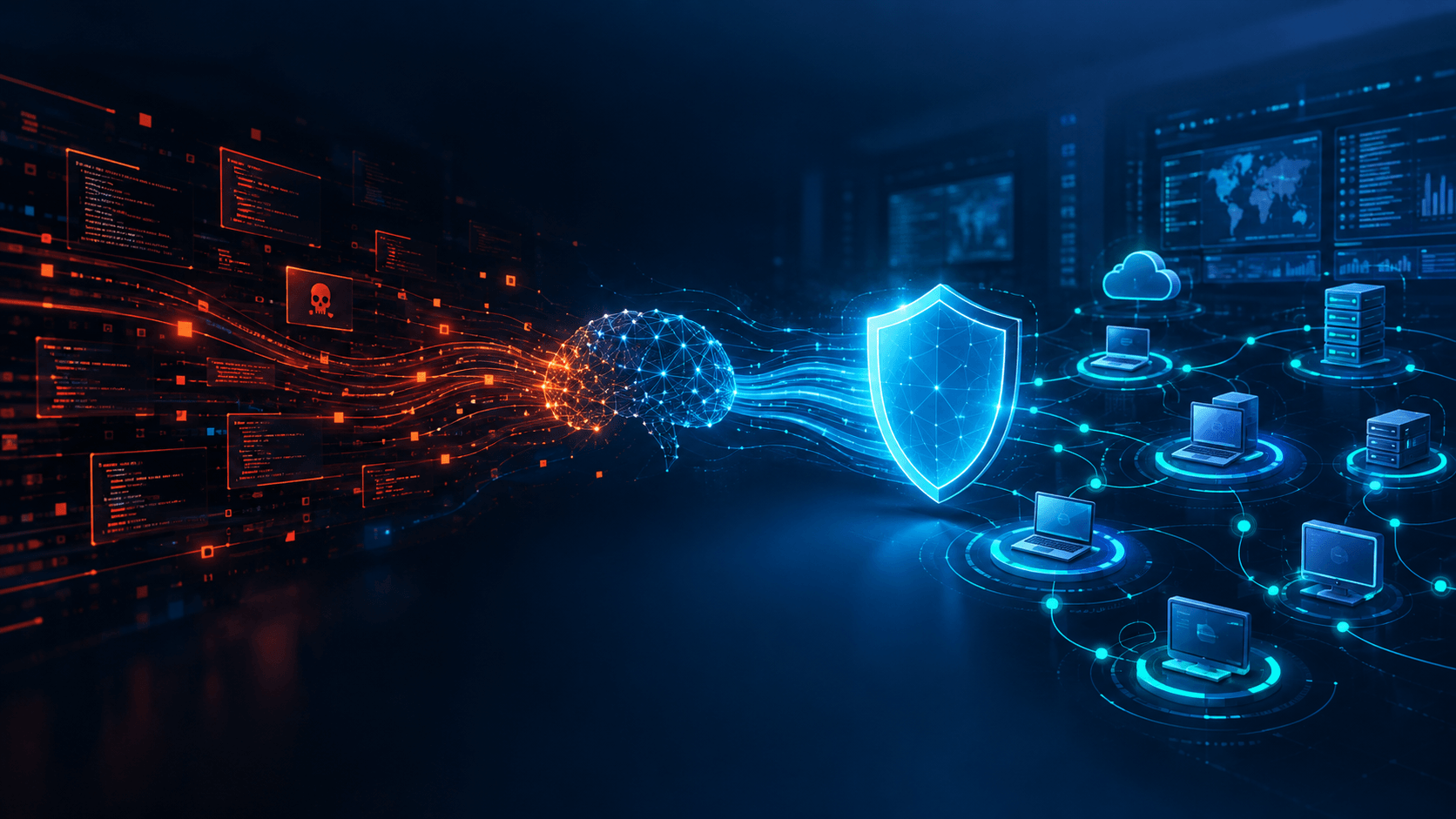
The same technology can help security teams analyse large volumes of activity, identify unusual behaviour and connect events that might otherwise appear unrelated.
Modern security operations can generate substantial quantities of alerts and telemetry. Analysts must determine which signals matter, whether they indicate genuine malicious activity and what action should follow.
AI-assisted tools can help prioritise alerts, summarise evidence, support investigations and accelerate certain response tasks. When integrated effectively, these capabilities can help defenders work at a speed that would be difficult to achieve through manual analysis alone.
However, the technology is not infallible. Automated systems can produce false positives, miss relevant activity or reach conclusions that require further investigation. Their effectiveness depends on the quality of the available data, the configuration of the tools and the expertise of the people overseeing them.
The advantage won’t come from AI alone. It will come from combining effective technology with experienced security professionals, sound processes and the ability to act on what the technology identifies.
The emerging risk of AI agents
One of the most important developments is the move from AI systems that simply generate answers to agents that can interact with other software and perform tasks.
Depending on their configuration, AI agents may be able to search files, access business applications, interact with websites, execute code or initiate workflows. These capabilities can improve productivity, but they also introduce new security considerations.
An agent that has access to sensitive information or operational systems becomes part of the organisation’s security environment. If its permissions are excessive, its instructions are manipulated or its connected credentials are compromised, the consequences could extend beyond an inaccurate answer.
Sir Ken McCallum highlighted how terrorists had sought to exploit AI to improve reconnaissance and attack methodologies, including the use of AI-enabled drones. He also warned of the potential for AI to increase the risks associated with bioweapons, while making clear that this particular threat had not yet been realised.
These are serious national security concerns, and they should not be conflated with the more routine risks facing commercial organisations. However, they demonstrate why AI capabilities must be assessed in terms of what they enable an individual or system to do, rather than simply which model or application is being used.
For businesses, the corresponding questions are practical:
- What information can an AI application access?
- Which systems can an AI agent interact with?
- Can it perform actions independently, or must a person approve them?
- Can its activity be monitored and investigated?
- What happens if an agent is manipulated, compromised or behaves unexpectedly?
These questions should be answered before AI systems are given access to sensitive data or important business processes, not after an incident occurs.
Why AI security needs to become part of cyber defence
Traditional endpoint protection, identity security and network monitoring remain essential. But as AI becomes more deeply integrated into business operations, organisations also need to understand the activity taking place within their AI environments.
This is where AI Detection and Response (AIDR) is becoming an important area of security.
AIDR focuses on improving visibility into AI applications and agents, identifying potentially malicious or risky activity, and enabling appropriate intervention. Depending on the capabilities of the platform, this may include discovering AI usage, monitoring interactions, applying controls and supporting investigations into suspicious behaviour.
Consider an AI agent connected to a business knowledge base. It may be authorised to retrieve documents and summarise information for employees. If a malicious instruction attempts to make the agent retrieve information outside its intended scope, the organisation needs appropriate safeguards to prevent unauthorised access and identify suspicious activity.
Effective protection requires several layers. Access controls limit what the agent can reach. Data protection policies govern sensitive information. Monitoring helps establish what happened. Detection and response capabilities can then help security teams investigate and contain activity where necessary.
No single tool replaces these foundations, and not every AI-related risk can be detected through one security platform. Organisations should assess capabilities against their actual AI use cases, systems and risk profile.
How Mondas is approaching AI detection and response
As a CrowdStrike premium partner, Mondas is implementing CrowdStrike Falcon Guardian for clients to help address the emerging security challenges associated with AI.
The focus is on improving visibility and control over AI activity, helping organisations understand how AI is being used and supporting the detection and response capabilities needed to manage evolving risks.
This reflects a broader principle in modern cyber security: organisations need to understand not only who and what is accessing their systems, but also how increasingly autonomous technologies are interacting with those systems and information.
AI security should form part of the wider security architecture, alongside endpoint protection, identity management, security operations and incident response. Its value depends on how effectively these capabilities work together and how well they are aligned with the organisation’s operational requirements.
🔗Explore CrowdStrike’s Falcon Guardian platform.
What UK businesses should do now
The developments highlighted by MI5 are a reason to review existing security arrangements, not to assume that every organisation needs the same response.
A proportionate approach starts with understanding the business’s exposure and strengthening the controls that reduce the likelihood and impact of an incident.
1 – Understand your exposure to AI
Identify the AI services and agents used across the organisation, including those introduced by individual teams. Establish what information they process, which systems they connect to and whether they can take actions independently.
2 – Review identity and access controls
Apply the principle of least privilege to users, applications and AI agents. Review connected accounts, API credentials and integrations, and remove unnecessary permissions. Where an agent can initiate consequential actions, consider whether human approval should be required.
3 – Strengthen protection against social engineering
Update awareness training to reflect more convincing AI-generated communications, voice impersonation and targeted fraud. Maintain independent verification procedures for payments, changes to bank details, sensitive requests and unusual instructions from apparent colleagues or suppliers.
4 – Improve detection and incident response
Assess whether your security tools can identify suspicious behaviour across endpoints, identities, cloud services and AI applications. Make sure alerts are investigated, response responsibilities are clear and incident procedures are tested.
5 – Review supply-chain and operational dependencies
Understand which suppliers and external services are essential to your operations. Consider how a cyber incident affecting a key provider could disrupt your own business, and establish practical arrangements for continuity and recovery.
6 – Make AI risk part of governance
Assign responsibility for AI security across IT, information security, data protection and business leadership. Document acceptable uses, review higher-risk deployments and reassess controls as capabilities and business requirements change.
Organisations processing personal data must also consider their obligations under the UK GDPR and the Data Protection Act 2018, including appropriate security measures and the protection of personal information.
🔗Read the Information Commissioner’s Office guidance on AI and data protection.
Preparation matters more than prediction
MI5’s warning illustrates the growing importance of AI within a wider national security and cyber threat landscape. Hostile states, criminal groups and other malicious actors have different objectives, but the technology available to them is changing how some threats can be developed and delivered.
For businesses, the sensible response is neither to dismiss these developments nor to assume that the most extreme scenarios are imminent. It’s to understand the risks relevant to their operations, maintain effective security fundamentals and ensure that emerging technologies are introduced with appropriate controls.
AI can strengthen defence, but it also creates new opportunities for misuse. Organisations that combine visibility, sound governance, well-configured security tools and experienced human oversight will be better placed to respond as the landscape evolves.
At Mondas, we help organisations assess their cyber security requirements and strengthen their ability to detect, investigate and respond to threats. Through our work with CrowdStrike and the implementation of Falcon Guardian, we are also helping clients address the emerging security considerations associated with AI.
If your organisation is adopting AI or reviewing whether its cyber defences are keeping pace with the changing threat landscape, contact Mondas. We can help you understand your exposure, identify practical improvements and determine where additional protection or monitoring may be appropriate.
About the author
Chris Wilkes-Green is Operations Director at Mondas Consulting, supporting the delivery of cyber security services and helping organisations strengthen their operational resilience.